SALMAN TOOR: SOMEONE LIKE YOU
The Courtauld Institute of Art
Somerset House
Strand
London, WC2R 0RN
2 October 2026 - 10 January 2027
REVIEW by KATHLEEN BONDAR
The contemporary artist Salman Toor (b.1983), born in Lahore, Pakistan and now living in New York, sums up his work as depicting “queer and immigrant lives that straddle different cultures and inhabit the tension between intimacy and exposure, belonging and estrangement. What it means to find a community, but also the daily costs associated with visibility”. Having lived most of his adult life in New York, he portrays that life with arresting and yet dreamy representations of queer South Asian men and others in bars, taxis and bed. Equally, he brings his experience of immigration to canvas where it all began, at border control, as he leaves Pakistan in the aftermath of 9/11 having received a full scholarship to attend Brandeis University in the States.
The Courtauld exhibition showcases 19 of Toor’s recent paintings, all created since 2019. The year marked a confident change in Toor’s visual references to his sexuality, which had been oblique, to overt. With titles like Three Friends in a Cab (2021), The Joke (2024) and Cross Street (2025), Toor shows a reckless, intimate, urban life in which men languish together. Cross Street, a London street scene, highlights the performance of masculinity, charged with sensuality. In other paintings there are an occasional exposed penis and abandoned coupling. Pillow Fight (2022) depicts a fun sex scene, whilst Back Lawn (2021) shows a sneaky grab at passion with oblivious guests nearby enjoying a garden party.
Fag Puddle with Carriers (2026) painted especially for the exhibition depicts a vigil-like procession as a documentation of trauma, in this instance the fallout from homophobia, inspired by Lorenzo Lotto’s The Entombment (1550-55). The term “fag puddle” was coined by Toor to remember and defy homophobia, as Richard Meyer explains in his contribution to the catalogue accompanying the exhibition.
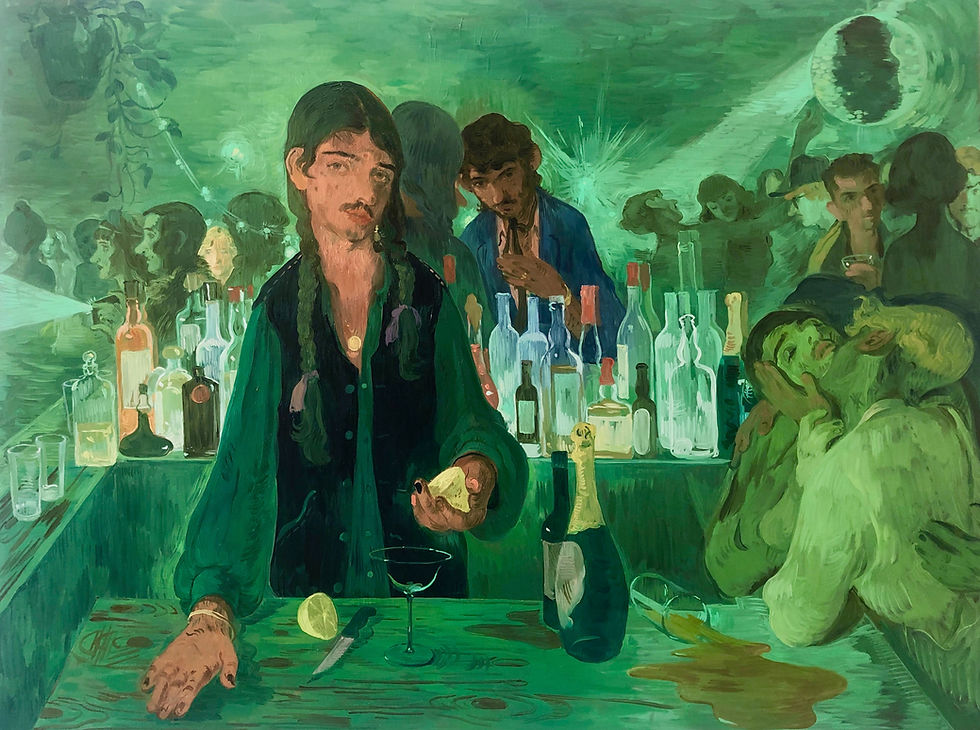
The Bar on East 13th (2019) is one of the first paintings using Toor’s characteristic green palette, which he admits is a tricky colour but one which conveys a cocooned, intimacy in a dark space, like a bar. Similarly, the unique quality of light from a mobile phone is another tool used in his work to illuminate people’s faces whilst absorbed or distracted.
Salman Toor: Fag Puddle with Carriers (2026); Citizens (2022); Three Friends in a Cab (2021)
As for Toor’s experience of immigration, Man with Face Creams and Phone Plug (2019), Group B (2020) and Citizens (2022) come together as a narrative of his experience arriving at as an outsider before a different country and culture. Man with Face Creams and Phone Plug relates to Toor’s experience of travelling as a gay South Asian man, nails painted with his toiletries laid bare before a customs officer.
Toor is absorbed by the history of art. Many of his paintings reference the Old Masters with nods to Edouard Manet’s A Bar at The Folies Bergere (The Bar on East 13th), Diego Valesquez’s The Super at Emmaus (Lunch, 2019) and Pablo Picasso’s Portrait of Jaume Sabartes (Group B, 2020). Ghost Ball (2023), one of the artist’s largest and most ambitious paintings, presents a group of figures dancing inspired by Dancing Villagers (c.1730), attributed to Pandit Seu who worked in India in the 18th century.
It is a small exhibition, only two rooms, although it is accompanied by a display of Toor’s works on paper, including Fag Puddle in Vitrine (2021). But as the saying goes, “small but perfectly formed”, this collection of Salman Toor’s work is a gem.


